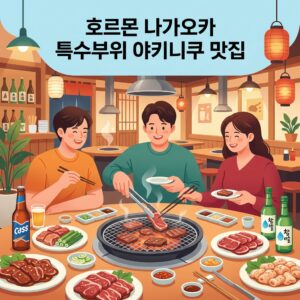
Hormon Nagaoka : A Local Yakiniku Restaurant Near Osaka Castle
When I think about eating yakiniku in Osaka, the first places that usually come to mind are the famous downtown areas and restaurants popular with tourists.
In the past, I often chose restaurants that were easy to reach or already well known among visitors. But this time, I wanted something a little different.
The restaurant I visited was Hormon Nagaoka, located not far from Osaka Castle.
If Shintan, the yakiniku restaurant I visited in Susukino, Sapporo, was a place where I could enjoy a variety of offal cuts in a relatively clean and stylish atmosphere, Hormon Nagaoka had a completely different charm.
In one sentence, I would describe it as:
“A genuine local yakiniku restaurant where neighborhood customers come to eat, rather than a restaurant designed for tourists.”

A Local Yakiniku Restaurant That Was Better Because It Wasn’t Fancy
Hormon Nagaoka is not a large restaurant.
When I visited, there was a small counter area that could seat around eight people, along with several tables. Because of its compact size, it felt more suitable for enjoying yakiniku with a small group rather than having a large and noisy gathering.
The interior isn’t particularly stylish or designed for taking Instagram photos.
But honestly, that was one of the things I liked about it.
The walls, tables, charcoal grill, and the smell of meat cooking all came together to create the feeling that this was a place where local people actually came to eat yakiniku.
Hormon Nagaoka is currently known as a popular yakiniku and horumon restaurant in Osaka, and it was also selected for the 2025 Yakiniku WEST 100 Best Restaurants by Tabelog.

Reservations Take a Little Effort, But They’re Worth It
One thing to keep in mind is making a reservation.
Calling the restaurant directly in Japanese is probably the most reliable option, which can be a little intimidating if you don’t speak Japanese.
If you have a Japanese friend, you can ask them to make the reservation for you. Another option is to ask the front desk at your hotel to call the restaurant on your behalf.
I’ve found this to be quite useful when visiting smaller local restaurants in Japan.
According to the current restaurant information, reservations are available and the restaurant provides a phone number for inquiries.
So I wouldn’t say this is a restaurant that is “too difficult for tourists to visit.”
Rather, it’s a place where making a little extra effort to reserve a table is worth it.
The Real Attraction Is the Variety of Offal Cuts
The biggest reason I enjoyed Hormon Nagaoka was definitely the menu.
This time, I ordered a variety of cuts, including harami (skirt steak), loin, and flap meat, as well as several less common cuts such as jomi-no (upper stomach), daidōmyaku (large artery), teiru (oxtail), urte (throat cartilage), and mochishin (Achilles tendon).
For me, the offal and specialty cuts were much more interesting than the standard beef cuts.

One of my Japanese friends is a huge fan of offal, and jomino (jomi-no) is one of his favorite cuts.
It comes from the cow’s first stomach and has a distinctive crunchy yet springy texture.
Another cut I tried properly for the first time was daidōmyaku, or the large artery.
These kinds of cuts aren’t always easy to find on the menu at an ordinary yakiniku restaurant. At Hormon Nagaoka, however, there are plenty of specialty cuts to choose from, which makes ordering a little of everything part of the fun.
Urte and Mochishin Were the Most Memorable
Among everything I tried, urte and mochishin were probably the most interesting.
Urte, sometimes written as urute, is a cartilage cut from around the cow’s trachea. It has a distinctly crunchy texture that makes it quite different from ordinary beef.
Mochishin, meanwhile, is made from the Achilles tendon and has an extremely chewy and firm texture.
These cuts are completely different from tender cuts like loin or harami that practically melt in your mouth.
That’s exactly what makes them fun.
They may not be for everyone, but if you’re someone who enjoys different textures rather than simply looking for the most tender piece of meat, they are definitely worth trying.

Thinly Sliced Oxtail Was Another Surprise
Another memorable dish was teiru (テール), or oxtail.
The oxtail is thinly sliced and grilled, which gives it a completely different character from the usual yakiniku cuts.
Personally, this was one of the first times I had encountered such a wide variety of specialty cuts in a single yakiniku meal in Osaka.
I think that’s one of the best things about this restaurant.
Instead of ordering large portions of the usual cuts, you can order several different types in smaller quantities and compare their flavors and textures.
Hormon Nagaoka is also known for serving Japanese black wagyu along with a variety of rare cuts, making it a particularly interesting place for people who enjoy exploring different parts of the animal.
The Seasoning Was Just Right
I also liked the seasoning.
Even with the specialty cuts, the seasoning wasn’t overly strong or salty. It seemed designed to complement the natural flavor of the meat rather than overpower it.
At first, I found myself thinking about having it with soju or beer.
But as the meal continued, I started thinking that Japanese sake or even wine would also pair surprisingly well with the meat.
Switching between cuts such as harami and loin and the more unusual offal kept the flavors and textures changing throughout the meal, so I never felt bored with what I was eating.

A Convenient Stop After Visiting Osaka Castle
Another advantage of Hormon Nagaoka is its location.
The restaurant I visited is conveniently located around the Osaka Castle and Temmabashi area, making it easy to combine with a day of sightseeing.
Tabelog currently lists Hormon Nagaoka Temmabashi as being about a two-minute walk from Temmabashi Station. The restaurant specializes in both yakiniku and horumon.
The surrounding area also feels calmer and more residential than the major tourist districts.
It was a nice opportunity to experience a different side of Osaka.
Having dinner here feels quite different from eating in crowded tourist areas such as Dotonbori or Namba.

Who Would I Recommend Hormon Nagaoka To?
Personally, I wouldn’t recommend this restaurant to absolutely everyone.
It’s more of a place for people with a specific taste in yakiniku.
I think it’s especially suitable for:
- Travelers looking for a more local yakiniku experience in Osaka
- People who prefer specialty cuts over standard loin and short ribs
- Fans of horumon such as mino, urte, large artery, and tendon
- People who enjoy trying many different cuts in one meal
- Travelers who prefer authentic local restaurants over stylish tourist-oriented spots
- Anyone looking for dinner around Osaka Castle or Temmabashi
If you’re the kind of person who thinks “the specialty cuts are more interesting than the regular beef at yakiniku restaurants,” you’ll probably have a great time here.
Not Fancy, But Definitely Memorable
Among everything I tried — harami, loin, flap meat, jomi-no, daidōmyaku, teiru, urte, and mochishin — it was difficult to choose just one favorite.
The standard beef cuts were delicious, but the most memorable part of the meal was definitely trying the specialty cuts that I don’t normally get to eat.
If Shintan was a place where you could enjoy specialty cuts together with a stylish atmosphere, Hormon Nagaoka felt more like a local yakiniku restaurant focused on the meat itself and the variety of cuts available.

So rather than comparing the two directly, I think the better choice depends on what kind of experience you’re looking for.
If you want stylish surroundings along with good yakiniku, go to Shintan.
If you want to eat a wide variety of specialty cuts and experience something closer to a local Japanese yakiniku restaurant, Hormon Nagaoka is the better choice.
That was probably what made this restaurant one of the most memorable meals of my Osaka trip.
There was no flashy interior and no special presentation designed for tourists.
Instead, there was simply good meat and a surprisingly wide selection of specialty cuts for people who genuinely enjoy horumon.
For someone like me who actively looks for cuts such as mino, urte, daidōmyaku, and mochishin, Hormon Nagaoka is definitely a local Osaka yakiniku restaurant worth putting on the list.
In one sentence:
A local yakiniku restaurant that focuses more on the meat and specialty cuts than flashy surroundings. If you want to experience authentic horumon and a wide variety of unusual cuts in Osaka, this is a place worth remembering.
tyfather




댓글 0
첫 댓글을 남겨보세요.